
Design
The Future Requires Collaboration
Building the Future Through Collaboration
No single organisation, municipality, or institution can build the future economy alone.
As technology, infrastructure, and public systems continue evolving, communities will need stronger local capability, practical participation opportunities, and new forms of collaboration that connect people more meaningfully to the systems shaping their future.
AIDE operates through a coalition-based model that brings together municipalities, communities, educators, industry, infrastructure partners, technologists, local businesses, and implementation teams into connected Human Infrastructure ecosystems.
The objective is not to replace existing systems.
The objective is to help connect them more meaningfully through shared participation, collaboration, and practical local activity.


CONNECTED SYSTEMS. SHARED PROGRESS.
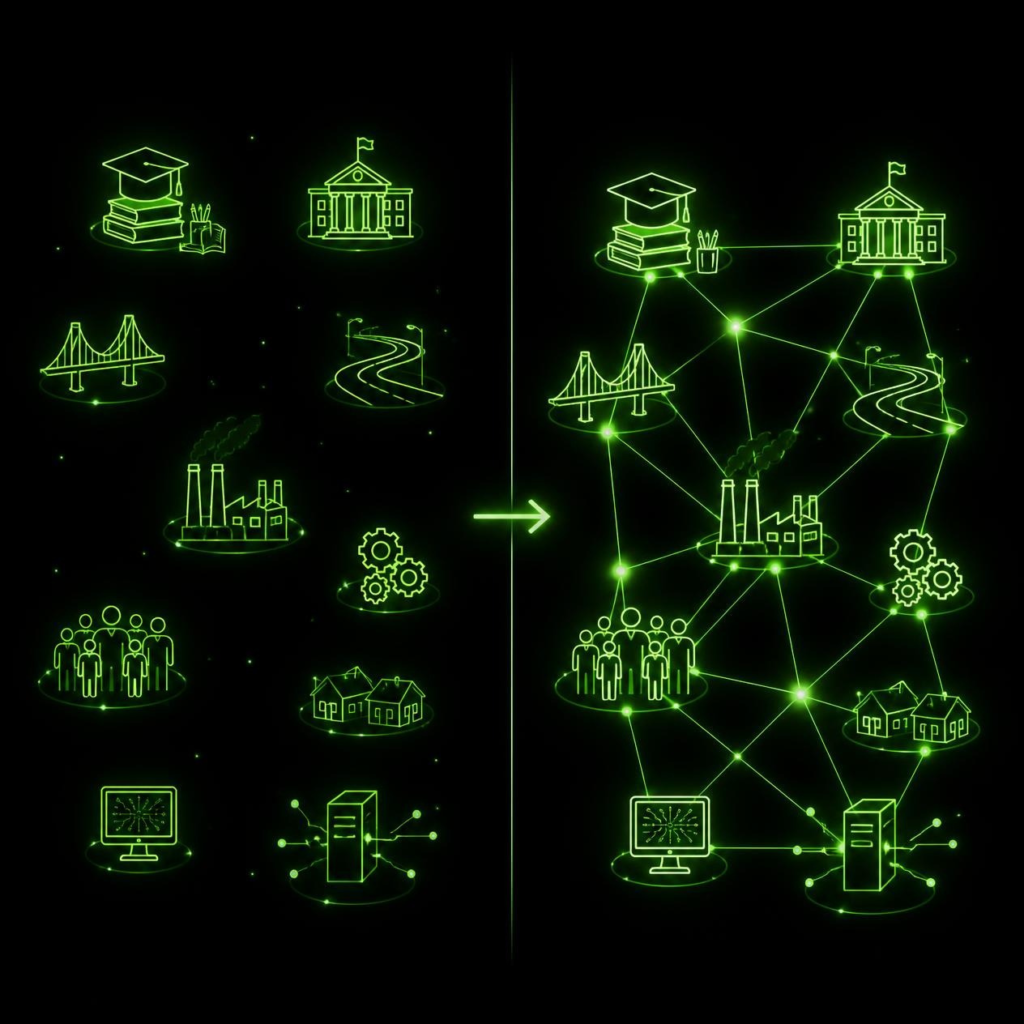
Many of the systems needed for the future economy already exist.
The challenge is that they often operate separately, without enough connection to local participation, workforce development, or community economic opportunity.
The AIDE Coalition helps bring these systems together through practical collaboration between municipalities, educators, infrastructure partners, industry, local enterprise, and communities themselves.
This creates stronger local ecosystems where learning, infrastructure, participation, technology, and economic activity become more connected over time.
Rather than isolated programmes operating independently, the coalition focuses on building practical local environments capable of supporting long-term capability, resilience, and participation.
MUNICIPALITIES AS LOCAL PARTNERS
Municipalities are central to the future of Human Infrastructure.
As local government systems modernise through digital transformation, smart infrastructure, AI-assisted systems, and connected public services, communities will need stronger local support to participate confidently within these changing environments.
AIDE works alongside municipalities to help strengthen local ecosystems through:
- digital public participation,
- smart infrastructure support,
- workforce readiness,
- youth participation,
- community technology projects,
- and digitally ready communities.
This may include practical collaboration connected to smart municipal systems, connected infrastructure, digital public services, local technology initiatives, and future workforce development.
The goal is to help municipalities strengthen local participation alongside technological transformation.


BUILDING LOCAL CAPABILITY TOGETHER
Industry participation is essential to building stronger local economies and future workforce capability.
The coalition creates opportunities for businesses, infrastructure partners, educators, and technology organisations to contribute toward practical local participation and capability development.
This is not only about economic growth.
It is also about helping communities participate more meaningfully in the systems shaping the future around them.
For many young people, technology and artificial intelligence can still feel distant or intimidating. But confidence grows when people begin participating directly in building, supporting, and understanding the technologies emerging around them.
This may include participation connected to smart device assembly, smart poles, connected infrastructure, environmental monitoring systems, automated irrigation technologies, renewable systems, local manufacturing, and community technology projects.
As local capability grows, more knowledge, opportunity, and economic activity can remain within municipalities and regional economies.
CONNECTING LEARNING TO REAL OPPORTUNITY
Education and workforce systems are changing rapidly as technology, automation, and digital systems continue reshaping industries and public services.
Many young people still struggle to move from learning into meaningful economic participation.
AIDE believes learning should connect more directly to real-world contribution, practical capability, and economic opportunity.
The coalition works alongside educators, TVET colleges, schools, training institutions, municipalities, and industry partners to help strengthen pathways between learning, participation, local systems, and economic activity.
This is not about replacing traditional education.
It is about helping strengthen it through practical participation models where people can learn, contribute, build confidence, gain real-world experience, and begin participating economically while developing future-ready capability.
Participation may include involvement connected to smart infrastructure, digital public systems, local manufacturing, connected devices, renewable systems, automated irrigation, food systems, and community technology projects.
The objective is to help communities build future-ready capability while creating stronger local participation economies.


BUILDING PARTICIPATION FROM THE GROUND UP
Communities are not passive recipients of development.
They are essential participants in the future economy.
The coalition supports local ecosystems where people can contribute, build capability, support local systems, and participate more meaningfully in economic activity connected to their communities.
Depending on local priorities, this may include community participation hubs, smart infrastructure projects, food and agriculture systems, local enterprise development, youth participation initiatives, renewable systems, local manufacturing, and district collaboration.
Real participation grows through practical local involvement, shared contribution, and visible opportunity.
TECHNOLOGY REQUIRES HUMAN PARTICIPATION
South Africa’s transition toward Digital Public Infrastructure, connected public systems, and AI-assisted environments will require more than technology alone.
Communities will also need confidence, capability, participation opportunities, and stronger understanding of the systems emerging around them.
For many people, rapid technological change can feel uncertain or disconnected from everyday life.
The coalition model helps communities move from fear and exclusion toward confidence and participation by creating practical opportunities connected to real-world systems and local economic activity.
The goal is not only digital transformation.
The goal is ensuring that communities are able to participate meaningfully in shaping and supporting the future around them.


BUILDING THE FUTURE TOGETHER
AIDE is building a growing ecosystem of municipalities, communities, educators, industry partners, technologists, infrastructure stakeholders, and implementation teams working together around shared local participation and development.
The ecosystem grows through collaboration, shared learning, practical participation, and connected local activity.
The long-term vision is to help South Africa build stronger local ecosystems capable of supporting workforce capability, digital readiness, economic opportunity, and meaningful participation within the future economy.
Building Connected Systems for the Future Economy
The future economy will depend not only on technological advancement, but on whether people, municipalities, institutions, and local economies are able to participate meaningfully within the systems shaping that future.
Smart Infrastructure requires Human Infrastructure.